

Meet the Residents
Take a walk through Beelina Sanctuary
Beelina Sanctuary is home to sheep, goats, cows, pigs, emus, and a few unforgettable personalities along the way.
Many arrived sick, injured, or simply without a safe place to go. Today they spend their days grazing the pastures, exploring the fields, and living peacefully here at the sanctuary.

Life at the Sanctuary
Life at Beelina Sanctuary moves at a slower pace.
Sheep graze across the pastures, goats explore anything they can climb, and the rest of the residents spend their days doing what animals do best — enjoying sunshine, fresh grass, and a peaceful place to live.
Everyday here is centered around care, routine, and giving each resident the space to simply be.

The Flock
The sanctuary is home to more than one hundred sheep representing several breeds.
Some arrived as bottle babies, others came from farms where they were no longer wanted, and many simply needed a safe place to land.
Today they live in two pasture groups we affectionately call the Woolies and the Hairies.

The Woolies
The Woolies are the sheep that grow traditional wool coats — soft, dense fleece that requires regular shearing.
This group includes Babydolls, Southdowns, Suffolks, and a Dorset each with their own distinct look and temperament.
They spend their days grazing together across their pasture, often forming small groups that shift and settle throughout the day.
About the Breeds
Babydolls, Southdowns, Suffolks & a Dorset are traditional wool sheep known for their calm temperaments and distinctive features.
Each breed brings its own personality and presence to the flock.
Life in the Pasture
The woolies move together but naturally form smaller groups throughout the day.
Some stay close, others wander a bit farther, but they always settle back into the rhythm of the flock.
Babydolls
Olde English Babydoll sheep are a heritage breed known for their small size, woolly coats, and distinctive teddy-bear faces.
They're often the easiest to spot — and usually the first to wander over and see what you're doing.
.png)
Lily
Lily’s story is still on the way. Sanctuary life is busy, and the donkeys are not helping by eating our notes.
Jemma
Jemma's story is still on the way. Sanctuary life is busy, and the donkeys are not helping by eating our notes.
Olive
Olive's story is still on the way. Sanctuary life is busy, and the donkeys are not helping by eating our notes.
Sunshine
Sunshine's story is still on the way. Sanctuary life is busy, and the donkeys are not helping by eating our notes.
Mambo
Mambo's story is still on the way. Sanctuary life is busy, and the donkeys are not helping by eating our notes.
Snowy
Snowy's story is still on the way. Sanctuary life is busy, and the donkeys are not helping by eating our notes.
Blizzard
Blizzard's story is still on the way. Sanctuary life is busy, and the donkeys are not helping by eating our notes.
Ella
Ella's story is still on the way. Sanctuary life is busy, and the donkeys are not helping by eating our notes.
Crazy
Crazy's story is still on the way. Sanctuary life is busy, and the donkeys are not helping by eating our notes.
Daisy
Daisy’s story is still on the way. Sanctuary life is busy, and the donkeys are not helping by eating our notes.
Sunny
Sunny's story is still on the way. Sanctuary life is busy, and the donkeys are not helping by eating our notes.
Hazel
Hazel's story is still on the way. Sanctuary life is busy, and the donkeys are not helping by eating our notes.
Southdowns
Southdowns are one of the oldest English sheep breeds and are known for their calm temperaments and rounded faces.
They tend to be more relaxed, often settling into the pasture and observing everything around them.
Aimee's story is still on the way. Sanctuary life is busy, and the donkeys are not helping by eating our notes.
Aimee
Lola's story is still on the way. Sanctuary life is busy, and the donkeys are not helping by eating our notes.
Lola
Suffolks
Suffolk sheep are easily recognized by their black faces and legs and are one of the most well-known sheep breeds in North America.
They're a bit more independent but always remain close to the flock.
Loretta's story is still on the way. Sanctuary life is busy, and the donkeys are not helping by eating our notes.
Loretta
Reba's story is still on the way. Sanctuary life is busy, and the donkeys are not helping by eating our notes.
Reba
Dorset
Dorset sheep are known for their versatility and are one of the few breeds that can breed year-round.
At Beelina Sanctuary, our Dorset is part of the Woolies pasture and fits right into the rhythm of the flock.
Shaniyah
Reba's story is still on the way. Sanctuary life is busy, and the donkeys are not helping by eating our notes.

Shearing Season
Each shearing season, the Woolies' fleece is carefully removed to keep them comfortable in Florida's heat.
That wool doesn't go to waste — we repurpose it into small handmade goods like dryer balls, shelf sheep & enrichment toys, allowing their care to continue supporting the sanctuary in a simple, sustainable way.
Small batches. Seasonal releases.

The Hairies
The Hairies are hair sheep — meaning they naturally shed their coats instead of growing wool that needs to be shorn.
This group includes Dorpers and Katahdins, both known for their resilience and adaptability, especially in warmer climates like Florida.
They move through the pasture with a slightly different rhythm, often spreading out more and thriving in the changing conditions around them.
Built for the Climate
Hair sheep are well suited to Florida's environment.
Instead of growing heavy fleece, they shed naturally, allowing them to stay comfortable without the need for seasonal shearing.
A Different Kind of Flock
While still part of the larger sanctuary flock, the Hairies tend to be more independent.
They spread out more, explore farther, and adapt quickly to their surroundings.

Dorpers
Dorper sheep were originally developed in South Africa and are known for their hardiness and ability to thrive in harsh conditions.
They're confident, adaptable, and well suited to the sanctuary's environment.
We’re still wrangling names, stories, and the occasional animal interruption — more coming soon.
Katahdins
Katahdin sheep are an American breed known for their parasite resistance and adaptability.
They are steady, resilient, and well suited to life in Florida's climate.
Coyote's story is still on the way. Sanctuary life is busy, and the donkeys are not helping by eating our notes.
Coyote
Sis' story is still on the way. Sanctuary life is busy, and the donkeys are not helping by eating our notes.
Sis

Naturally Adapted
Unlike the Woolies, the Hairies don't require shearing.
Their coats shed naturally with the seasons, allowing them to stay comfortable without intervention.
It's one of the many ways different breeds thrive in their own way here at Beelina Sanctuary.


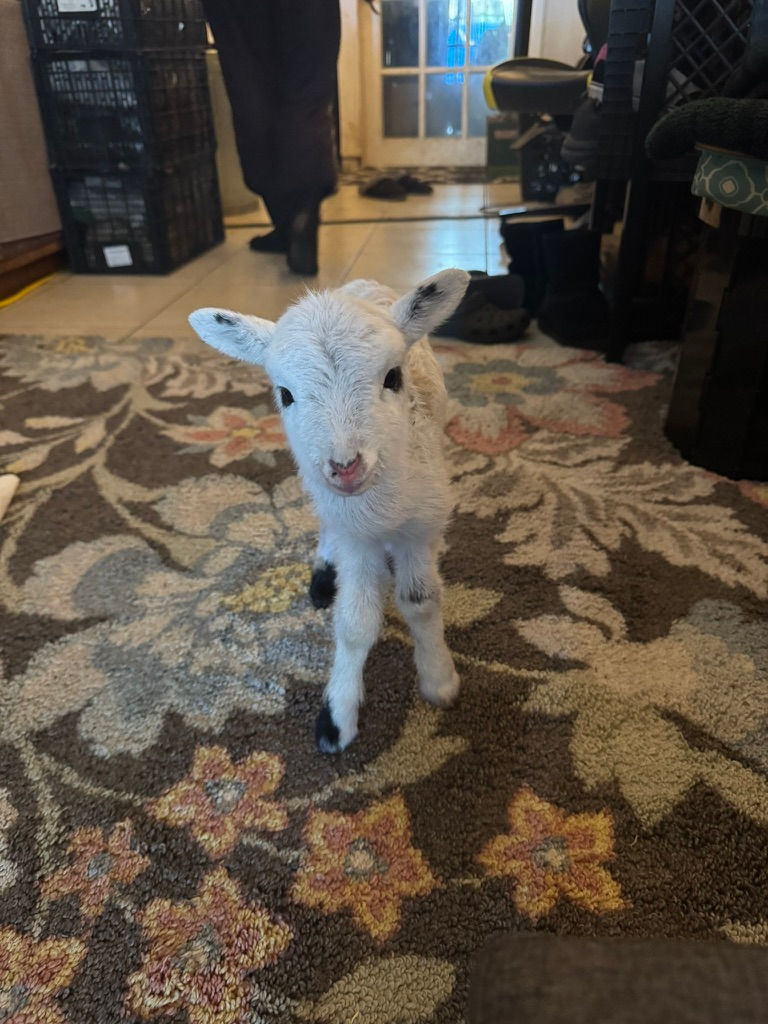


Tofu
Tofu has fully settled into life at Beelina Sanctuary — often alongside Butters (our self-appointed babysitter pup), and at least on occasion, representing the Bills Mafia (GO BILLS!)
She keeps close to where the people are, following me around the sanctuary and making it very clear she prefers this version of life.
It wasn't always that way.
Tofu arrived at just three days old, in need of round-the-clock care, proper nutrition, and the kind of early support she would normally receive from her mother — that's when I stepped in to give her the best start possible.
With frequent bottles and constant care, she slowly grew stronger, and as she did, we began preparing her to join the flock. It didn't take long to realize that wasn't the right fit for her, and after bringing her inside to recover (from the apparent horrors of the outdoors), she settled into a different kind of routine that suited her far better.
At this point, Tofu (& I) are fairly certain this is exactly where she's meant to be.

As you move further through the sanctuary, you'll start to notice a quieter presence.
The Moos
The moos are a small group here at the sanctuary — four in total — each with their own personality, preferences, and way of moving through the world.
They're mostly Jerseys, with one very special exception, and while they may share a pasture, they couldn't be more different from one another.
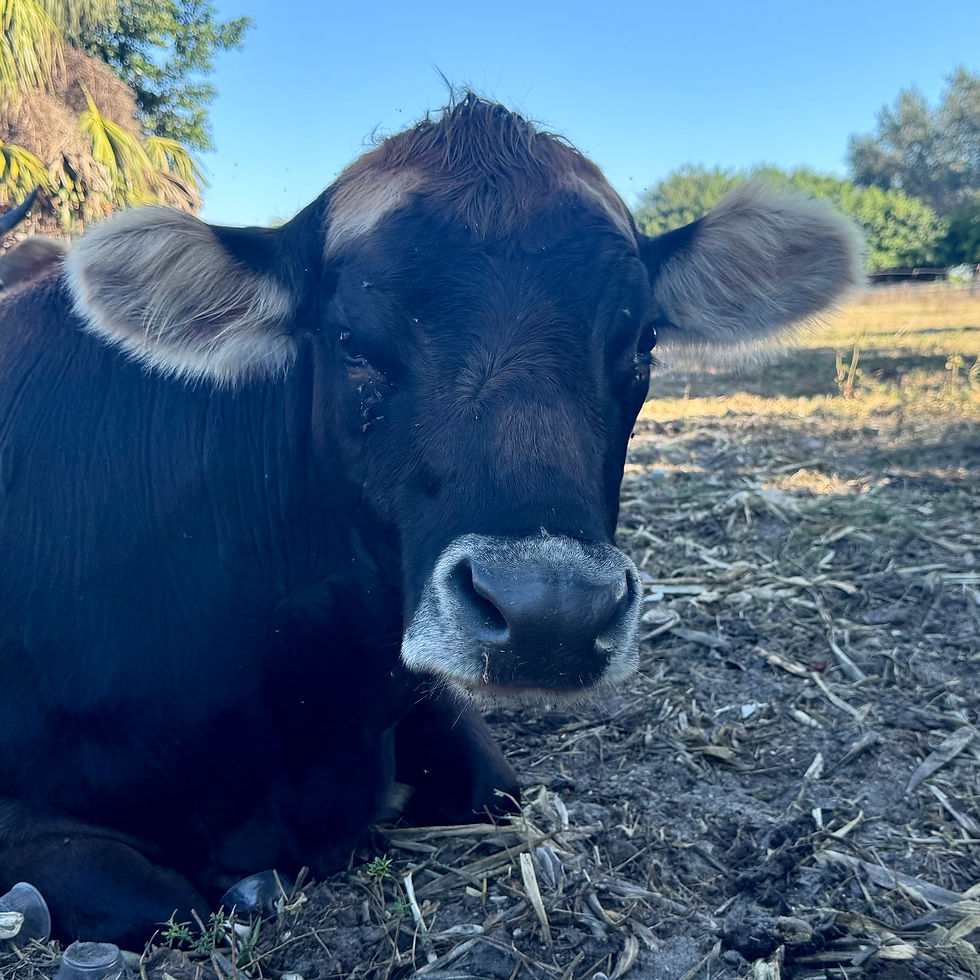
Jazz
Jazz is a little more on the standoffish side. She's not one to walk up just for anyone, and she's perfectly content keeping her distance and minding her own business. If she does wander over, though, and turns around to offer you her backside for scratches, you should really consider yourself lucky — that's her version of affection, and she doesn't hand it out lightly. Everything about her feels deliberate. She moves at her own pace, decides who's worth her time, and sticks to it.

Dolly
Dolly is the sweetest girl — she's just extremely enthusiastic about it. She doesn't always realize how big she is, especially when she's coming in for attention. Nothing about it is intentional, she just gets a little carried away with the love, horns and all. Her go-to move is planting her entire face right into your chest for neck and ear scritches, fully committed, no hesitation. When Kelly gets home, Dolly comes running — full speed, no questions asked. She doesn't even need a reason, she's just showing up.

Red
Red takes her time with people. New faces get a little distance at first, but once she decides you're safe, she flips completely. Sitting on her becomes fair game, and she'll pull you in with that strong head of hers like a full-on hug. Prior to calving season, she spent most of her time near the kunekunes and more or less adopted Taylor Ham as her baby. Mornings often included a trip to the emus for what we call sticker removal — they'd clean her face off for her if she made her way over.

Kira
Kira has absolutely no concept of personal space. Walking up behind you and licking your ponytail clean off your head is completely normal behavior in her world. If your face is within reach, you're getting the full sandpaper tongue experience whether you signed up for it or not. She loves a hug — standing, sitting, sideways, it doesn't matter — and she gives them freely. Most of her time is spent hovering around the calves as they're born, fully committed to her role as big sister whether anyone asked her to be or not.
Spend a little time there, and you'll notice something else — a presence that's a bit more observant.
The Equines
The equines move through the sanctuary a little differently.
There's a steadiness to them — slower, more deliberate, and quietly aware of everything around them.

Polo didn't arrive here with much trust. He had been left to fend for himself, eventually finding his way to a nearby cattle farm in search of food. When he was brought in, he was nervous, unsure, and clearly hadn't been given the care he needed for quite some time. Earning his trust wasn't immediate. It took time, consistency, and a lot of quiet moments before he started to settle in. These days, he carries himself differently — still aware, still observant, but far more at ease in his space.
Polo
Shetland Pony

Bella may be small, but she's been through more than her size would suggest. She was rescued out of Georgia after being born as a second baby to a mother who hadn't even finished nursing the first, and who wasn't given the nutrition needed to support another pregnancy. Bella came into the world tiny — and stayed that way. Despite that start, she's steady, soft, and quietly holds her own. She later had Pikachu, her daughter, who is very much convinced she runs the place. Bella doesn't argue with that — she just lets her.
Bella
Miniature Donkey

Pikachu may not be the biggest out there, but you wouldn't know it by the way she carries herself. She's got opinions, she's got confidence, and she's absolutely certain she's in charge — whether anyone else agrees or not. She keeps a close eye on everything going on around her, stepping in when she feels it's necessary and making sure her presence is known.
Pikachu
Miniature Donkey

Jack is a bit of an Eeyore-type — in the best way. He came from a home where he wasn't fed the proper diet, and he's carried that weight with him since arriving. These days, he's a little round, a little slower, and very much motivated by snacks. Most of his time is spent wandering, rummaging, and looking for the next opportunity for both snacks and affection. He's easy to love and all too aware of it.
Jack
Miniature Donkey

Ginger is.a striking red boy with a quieter presence. He doesn't push for attention the way some of the others do, but he's always nearby, watching, taking things in, and moving at his own pace. There's a calmness to him that balances the group — steady, observant, and content to be exactly where he is.
Ginger
Miniature Donkey

Keep going, and things start to feel a little more interactive.
The Oinks
The oinks bring a different kind of presence to the sanctuary.
They're curious, expressive, and always just a little more involved than you might expect — especially when there's food involved.

Taylor Ham was rescued as a runt after struggling early on with upper respiratory issues that studented his growth. You wouldn't know it now. He struts around the field like he owns it, fully recovered and very aware of his place here. Alongside Maple Bacon, he's part of the cleanup crew — when the sheep pick through their produce, the kunekunes come in behind them and make sure nothing goes to waste. He's easily one of the most lovable little guys out there. You'll often find him passed out in the hay, snoring away, completely unbothered. He loves a good belly rub and will always come running the second he spots his humans.
Taylor Ham

Maple Bacon was brought in as a companion for Taylor Ham and settled in almost immediately. She's a cute little rotund girl with plenty of personality and absolutely knows how to use it — especially when it comes to Aleks. A few well-timed eyelashes and she's pretty much gauranteed to get whatever she's after. Scratch her just right behind the ears and she'll tip right over, fully committed to the moment and ready for belly rubs. She's quickly become a perfect match for Taylor Ham, and the two of them rarely stray from each other.
Maple Bacon

And then, just when you think you've got a feel for things, something a little unexpected comes into view.
The Emus
The emus are...something else entirely.
They're curious, a little unpredictable, and always paying closer attention than you think — usually from just a bit too close.
Spend a moment here and you'll start to notice they're rhythm.
Quick, observant, and always just slightly out of sync with everything else around them.

Thomas
Tom came to Beelina as a chick after being rescued from an emu farm alongside Jerry. Both had developed splay legs, something that could have easily left them behind. With time, care, and a lot of attention, Tom grew out of it completely. These days, you’d never guess he ever struggled. He spends his time sprinting around the sanctuary at full speed, usually with Jerry close behind, like a feathery little roadrunner with somewhere very important to be. Quick, curious, and always on the move, Tom is a reminder of how much can change with the right start.

Jerry
Jerry was rescued as a chick from an emu farm along with Tom after developing splay legs. Without intervention, it’s the kind of setback that could have changed everything for him. Instead, Jerry got the time, care, and attention he needed to grow strong. He overcame it completely, and now you’d never know he had such a shaky start. These days, he and Tom race around together like a pair of full-speed roadrunners, always watching, always moving, and rarely far apart. Jerry’s story is a small but powerful example of what patient care can make possible.

T-Rexa
T-Rexa’s path to Beelina looked a little different. She was rescued after an injury to her neck, though the exact cause is unknown, and she still carries some lasting effects from it, including a bit of wry neck and a habit of “fly catching.” Even so, T-Rexa has made her own place here. She’s quirky, a little offbeat, and entirely herself — but once you spend a little time with her, her sweetness is impossible to miss. T-Rexa’s story is a reminder that healing does not always look the same, and that there is still so much worth loving in the wonderfully odd ones.

And just past that, things start to feel a little more lively.
The Goats
The goats bring a different kind of energy to the sanctuary — curious, expressive, and always in motion. There's rarely a quiet moment around them, and they seem to prefer it that way.
Spend a little time here, and you'll quickly realize they're equal parts personality and chaos — and entirely entertaining.

The Herd
The herd is made up of a mix of personalities, ages, and backgrounds — some more outgoing than others, but all equally determined to be part of whatever is going on.
They're natural exploreres, always testing boundaries, climbing anything they can, and somehow managing to turn even the simplest moment into something a little more eventful.

What to Expect
If you find yourself near the goats, expect to be greeted.
Sometimes enthusiastically. Sometimes all at once.
They're curious about everything — your shoes, your pockets, your intentions — and they're not shy about it. It's all part of how they interact with the world around them.
We’re still wrangling names, stories, and the occasional animal interruption — more coming soon.

And just beyond that, things begin to settle again.
Where It All Connects
Everything you've just seen is part of something larger.
Each animal here has a story, but none of them exist in isolation. The work that happens at Beelina Sanctuary connects across species — from the smallest pollinators to the largest residents in our care.
Why It Matters
Caring for these residents takes time, space, ancd consistency. It's daily work, long-term commitment, and a promise that once they're here, they're safe for life .
That work is made possible through a model that supports both animal welfare and environmental health — creating a system where each piece helps sustain the next.
How You're Part of It
Support doesn't just go one place.
Pollinator relocation helps fund lifelong care. Sanctuary work provides safe space for animals who need it. Community support helps keep everything moving forward.
There is no single entry point — just different ways to be part of it.
